







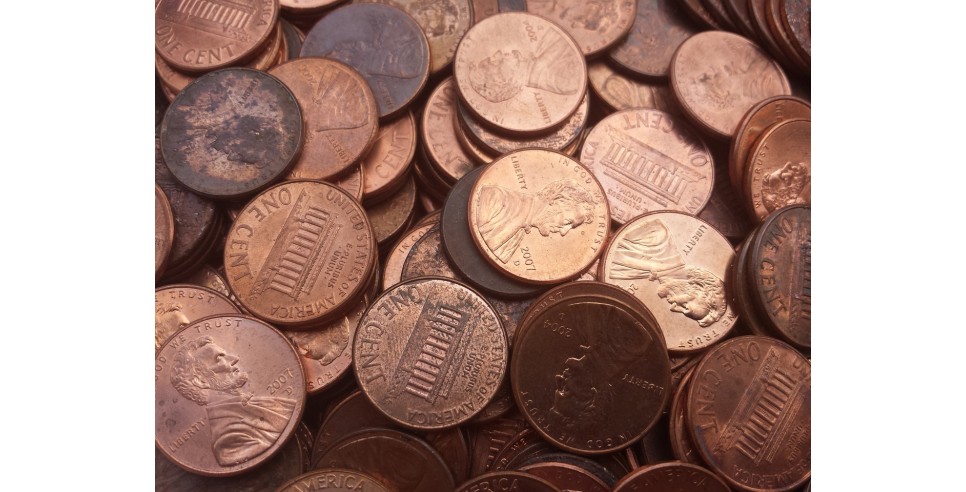
I have a mystical attachment to pennies. Found money is extraordinarily lucky. Everywhere I go, I’m in the habit of finding lucky money on the street. Sums range from the single penny stuck in a puddle to the fifty-dollar bill that had blown into my driveway the day after a gale-force windstorm.
I’ve also encountered freakishly placed piles of coins. One day as I walked through Downtown Seattle, I encountered three separate piles of coins. The total haul accumulated from all three piles was over three dollars. One of my favorite finds was exiting Grand Central Station onto Lexington Avenue during rush hour, where I found two crumpled one-dollar bills; it was as if someone tossed them at me like a ball, solely for my amusement.
I stash lucky money in funny places. Coins are deposited into piggy banks made from ceramic, bronze, leather or glass. Dollar bills are stuck surreptitiously in between the pages of well-worn books. I save my lucky money. The coins, I keep forever. The tens, twenties, and the fifty, are used to buy a unique present for someone I love.
Jump-cut to Seaside, Oregon, where I walk the Promenade (known as the Prom), sometimes alone, but more often I walk the Prom with my husband. The Prom is a one-and-a-half-mile paved walkway bordering the Pacific Ocean that extends from 12thAvenue in the North to Avenue U in the South. Paths from the Prom break out into tall, windswept grass, groves of pine trees opening to the beach, and a yawning stretch of the Pacific Ocean. In the fifteen years that I’ve walked the prom, I’ve only found one penny.
Finding the second penny on the Prom happened quite mysteriously.
One day in September, my husband and I had already walked the length of the Prom and were now heading back to our starting point. There is a roundabout in the center of the Prom where people can turn around. A bronze statue of Lewis and Clark stands in the Promenade as a memorial capturing the end of their long journey, where they turned around, away from the Pacific Ocean, to travel home.
Now my husband and I were traveling home. It was one of those times between us that can only be described as pensive. There is a lot of dissonance going on in life and it’s a great ballast to get out of this world to experience renewal, all of which means, we were walking together, but not talking. A thought popped into my mind: Here’s a penny for your thoughts.
In the next instance, I looked to the ground. On the side of the walkway in a thatch of dried-out, brown sea grass sat a lonely penny. I picked it up and handed it to my husband. “Here’s a penny for your thoughts,” I told him.
The quote “A penny saved is a penny earned” is attributed to Benjamin Franklin. Known for being frugal, Ben Franklin thought it was as useful to save money, even pennies, as it was to earn more money. There is a childish artistic rendering of Ben Franklin carrying three huge puffy rolls that he had purchase for a mere three pennies, while his wife Deborah Read looks on and laughs at him for such a paltry offering: Three rolls for three pennies!
Pennies have been deemed to be a prodigious failure as a mete of currency. Yet pennies still retain a certain cachet that is related to the state of which the lucky penny is found. If it’s heads-up, it’s lucky. If tails, then you must turn over the penny before picking it up and placing it into your pocket. A tails-up penny is a sure sign that there will be no windfalls, jackpots, grand inheritance, or trust funds in store for you. You will have to work for your money. One friend places her tails-up pennies inside of her shoe and must walk for a while, curing it to make it lucky.
One time I rode an elevator with a man whom I knew to be very wealthy. On the floor of the elevator car, a lone penny gleamed and called my name. I dove for the penny and stuffed it into my pocket. Looking chagrined, the man confessed, “I was waiting until you got off the elevator before I picked it up.”
It’s all about luck, you see. Once a well-known designer and I crossed a street in Downtown Seattle, where a stark penny loomed in the crosswalk. I thought we would wrestle to the ground to see who would first get the penny, but that did not happen. The designer intentionally stepped over the penny and said, “I’ll leave it there for someone else.”
That someone else was me. I exhibited no shame when I dove to the ground to claim my bounty. As for the designer, the rejection of the penny was commensurate with his waning career and earning power. Soon he would spiral into a tailspin that resulted in his steep decline. I doubt he realizes how powerful a message he sent to the universe when he stepped over the lowly penny.
So here is where the subject of pennies becomes odd and tricky. I am moving on to an altogether different topic that is seemingly disconnected but very relevant. It has to do with little people.
When my children were young, nine, six and one, to be precise, my car had suffered a mishap and was in the garage for repairs. My son’s summer camp was a mile from our home. Getting up early and walking to the camp was a healthy thing to do. Plus, we had time to talk about those things we never had a chance to discuss. I did not know then what I know now. The question my son asked me that day has instilled within me the firm resolution that some things cannot be explained.
As we approached a crosswalk, my son suddenly asked me about midgets. He wanted to know how midgets came to be. While his question seemed to be out of ordinary, I respected his curiosity. My response relied on my limited knowledge of genetics. He seemed satisfied with my explanation and admitted he had never actually seen a little person. Now here is where the story turns.
At the end of my work day, when camp was over, I returned to get my son, so we could walk home. As we approached the same crosswalk where we had discussed midgets in the morning, a middle-aged man, undoubtedly a little person, appeared in the crosswalk and walked in the opposite direction. I looked at my son; he looked at me; our eyes said everything. Was this a coincidence?
One of the best things about being human is that all of us have experienced the sensation of being stared at. We’re walking through a mall or sitting in a restaurant or about to get into our cars and we can just feel someone looking at us. We turn to see and sure enough there is someone watching our every move. We’ve also experienced thinking about someone, it could be about someone you have not thought of in years, and within minutes that person phones you. And why is it that your dog or cat knows you are close to home, long before they hear your footsteps or the sound of your car?
So now our story turns to energy. There are many forms of energy. The energy that heats our home might be derived from oil, gas, coal, electricity, hydropower, the sun or the wind. A very different form of energy emanates from life, from being physically active, mentally alert and working at the top of your game, and, of course, there are those forms of energy in the universe that are still not satisfactorily explained.
Rupert Sheldrake, who coined the term Morphic Field, proposed that memory is inherent in nature: in plants, trees, animals, and certainly in human beings. It’s why we just instinctively know things without actually having to learn them. Sheldrake further asserts that Morphic Fields extend beyond physical objects and people to tether us together, the same way the earth’s gravitational field extends far enough beyond the earth’s crust to keep the moon in orbit.
There are social groups of living creatures, fish and birds, for example, that embody the existence of morphic fields. Its why birds flying in a flock all turn in direction at the same time without crashing into one another.
There might be a metaphysical realm between this time and physical space or another dimension. As human beings, we’re always at a crosswalk. We will either descend into the depths of hell, hate, war, or evolve into a culture where sharing, compassion and collaboration is taken on face value. Heads up.
Maybe we all share the collective memory derived from what happened to our ancestors long before we were born into this world, and we don’t want to make the same mistakes. Maybe we’re all connected. Maybe not. I cannot explain the unexplained. Nor do I have a theory to offer you about energy, except to say that the next time you find a penny on the ground or see a little person, you will find it to be a good omen, and meaningful.
A Penny For Your Thoughts is an Essay in my collection NOTES FROM THE WORKING-CLASS.

Patricia Vaccarino
Patricia Vaccarino is an accomplished writer who has written award-winning film scripts, press materials, articles, essays, speeches, web content, marketing collateral, and eleven books.