









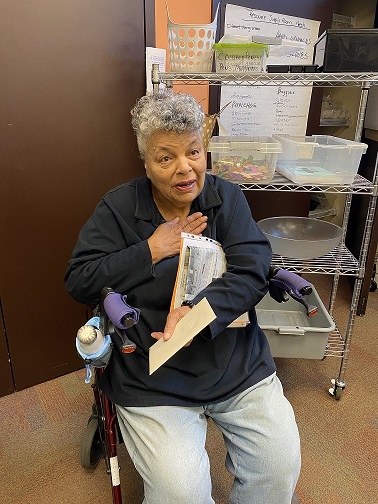
Jani Kelly is here with us now, a poet laureate for the soul, speaking soothing words of truth, love and light. Every Wednesday, just before noon, Jani reads a new poem to a group called Sacred Encounters. The volunteers who participate in the Sacred Encounters outreach group serve those who are experiencing homelessness. Their mission ascribes to an act of faith: everyone deserves to be loved, even the most unlovable among us.
The Sacred Encounters group is based at Christ Our Hope Catholic Church, located in the Josephinum in downtown Seattle. The Josephinum is operated by Catholic Housing Services. Aside from being the home of Christ Our Hope Church, the building has 221 low-income units and houses approximately 250 individuals.
One of the residents of the The Josephinum is Jani Kelly. How she became the poet laureate of an urban church is a journey that transcends time. Her journey began with a miracle. As a child she had a mastoid infection that left her deaf in one ear. The infection was serious and imperiled her life. After the doctors performed surgery, they were unable to remove the entire infection. Jani could hear the doctors telling her parents, “If you know any good prayers, you might want to pray.”
The infection never quite healed, but Jani was touched by a miraculous encounter. While she had lain in the hospital, almost dying, she felt everything within go silent, and she knew it was God.
Today Jani Kelly, a gifted poet and wheelchair bound resident of the Josephinum, has become a local legend. Her words are part prayer, part poetry, with a sprinkling of passion and a good dose of mysticism. On those cold, dark days when all is lost, and nothing will sustain you, Jani’s voice rings with the truth. This poet laureate speaks to your soul.
Seattle born and bred, Jani was an only child and attended low-income preschool the Saint Peter Claver Center in the Central Area. Why she spells her name as Jani is a story unto itself. When she was in the 5th grade, four girls, all named Janie nee Janey or Janee, wore the same uniform, so they decided to spell their names differently. Standing out from the pack, in a burst of creativity, she became Jani.
Throughout her childhood she had an affinity for writing and while she was in high school wrote a column in the Franklin Tolo, the semiweekly school newspaper, and sometimes her poetry appeared in its counterpart, a creative writing magazine.
Her poetry has undergone many iterations since she was a child. Her poetry of today is a testament to her wisdom, beauty and heartfelt Christian faith.
Faith sustains her and poetry nourishes her soul, a gift she passes on to countless others. Her poems of encouragement become the daily mantra guiding the Sacred Encounters’ volunteers as they venture into the street to care for the hardcore homeless, many of who are poor, mentally ill and fentanyl addicts.
Jani has had her own times of trial. She endured a difficult relationship with her mother that was problematic enough to make her want to leave home. Without going into the details, she described it as her mother's meanness. “My father was a sweetheart,” she says, but he worked in Bremerton, and stayed away during the week, and only came home on the weekends.
She wanted out of Seattle. She was nineteen years old at the time and opted for military service. Since she was under 21 at the time she worried that her mother would not sign the papers. At Jani’s behest, (she really wanted to go into the military), the Army recruiter came to Jani’s house to talk to her parents so they wouldn’t worry about what would happen to her while she was away.
Her mother told the recruiter that she’d think about it but her consent was not forthcoming. Jani told her Dad that if her Mom didn’t sign the consent papers, she was going to find a way to leave home anyway, and she’ll never know where I am, but if I go into the army, she’ll always know where I am. This simple declaration persuaded her mother to sign.
There were physical obstacles. Jani was deaf in one ear due to the mastoid infection that almost killed her, and she also had a slight heart murmur. She was hoping and praying that she would pass the Army’s physical, and she did. And that was nothing short of a miracle.
Jani was assigned to Fort McClellan, Alabama, where they had a separate training center for women. During World War II Fort McClellan was one of the primary U.S. Army camps, and had trained a half-million troops. In latter years, Fort McClellan became the home of the Women’s Army Corps. In the Post World War II years, many nations were trying to come to terms with the aftermath of war by restoring a semblance of normalcy, but there wasn’t anything normal about a woman of color living in the south before desegregation.
At Garfield high school Jani had friends belonging to every race and ethnic group. It came as quite a shock to live in a place where people were separated by their color. Jani and two other girls were heading to basic training from Seattle. The other two girls were white, but because Jani was the oldest of the three, she was put in charge of handling meal tickets and the cab fare from the Army’s recruiting office.
As soon as they landed in Atlanta, they went to the airport restaurant, where they were told to go for their meal. Every person in the restaurant was white. The only people that were black were the waiters. Jani explained to the maitre’d that they were instructed to have a meal there. “She took us and sat us down at a very nice table and everybody in the restaurant was staring. They weren't hostile or anything, I think they were just more curious than anything.”
Alabama was a completely different experience. When they arrived at the bus stop, they were told there was a place out back to eat. It was a long series of tables and a fire where several black men were cooking. “And there were flies zooming around and it didn't look terribly clean because it would be hard to keep clean.”
Inside the bus station, it was clean and spotless, so they went in and sat on the stools. The waitress came right over and told them they couldn’t eat there because of Jani. “You can eat here,” she told the white girls. “There's a place out back where colored people can eat.” Jani gave the girls the meal tickets and told them to go ahead without her.
They had to take a taxi to get to the next place. When the cab came, the driver said he could take the white girls but not Jani. “I have the cab fare,” Jani told him, “so where the cab fare goes, I go.” He told them to go ahead and they all piled into the car. The next phase of the journey was by bus. Jani needed to go to the back of the bus. In the next town, the army came and picked them up.
Once she was on federal property she entered a new world. On the Army base, women were required to wear skirts and suit jackets, a dress uniform, along with army-issued high heels. Her long hair was shorn to above her collar. Jani didn’t experience racial prejudice at the store that sold her high heels. Ironically, at the black beauty shop where she had her hair cut, the beauticians were not friendly. “They did not like people from the north coming down there,” Jani said.
The next time Jani went to town, a different lesson about racial overtones turned into somewhat of a shtick, humorous but scary, too. “We were on the base, waiting for the bus with a bunch of young men, all white except one young black man.” The bus driver told the group that the young black man could not sit up front with his group, that he had to go to the back of the bus. When questioned, the driver said it was Alabama law. The young men protested and said, “Hey, he's serving in the army just like we are. He shouldn't have to sit in the back of anybody's bus.” And they got off the bus. Then, they told to the driver, “If he can't sit anywhere on this bus, this bus ain't going to town.”
They started rocking the bus. “Hey, everybody get off the bus,” they yelled. So everyone got off the bus, but the driver stayed in his seat. “Hey, they yelled, you’re going to get off the bus because this bus ain’t going to town today.” The driver got off and Jani felt sorry for him. He was just doing his job. Sure enough, they turned that bus over.
One vivid recollection is the town square that was unkempt with overgrown grass, where they had a sign saying, no dogs or N******* alone. In this town of poor people, both white and black, they had to have two of everything, two bathrooms, two bars, two parks. The list of twos was endless and forced people to see either black or white, reinforcing racism and draining the town’s revenue.
Jani had committed to a three-year Army enlistment, but meanwhile, she also got married to Paul Kelly. She became a medic at Valley Forge Army Hospital in Phoenixville, Pennsylvania. A lovely one-horse town with one main street, Phoenixville had a housing shortage; it was hard to find apartments. At first Jani and her husband rented a room. Then the children came, Ronnie and Michael. When her husband got orders to go to Korea, Jani returned to Seattle with the children, not an ideal situation. Because Paul had a family, he was only required to stay in Korea for a year.
Good news came to the family when Paul was given orders to go to Germany. They lived in Bad Nauheim, a town known for its therapeutic salt springs and as the temporary residence for Elvis Presley from 1958 to 1960, while he served in the U.S. Army. Jani’s growing family now included a girl, Lisa. People came to Bad Nauheim from all over the world to soak in the salt waters. Jani and her family met a diverse range of people, and the children had to learn German in school. It was a fun and interesting time, shopping off-base in the local German markets, and getting to know the townspeople.
She shopped with a basket and came to love whole grain bread freshly baked in the bakery. The scent of baking bread permeating the streets told her it was time to go shopping. Soon bread would be available, fresh from the oven. The German vendors came know her, giving her extra cookies for the children and fresh produce.
She found German soap powder to be infinitely better than the American brands because the Germans used washing pots to launder their clothes. The washing pot was devised to conserve electricity. A boiling cauldron of soap and hot water on the stove mimicked the agitation cycle of a washing machine, resulting in fabulously clean clothes that were hung outside on a clothesline. Jani recalls the fragrant scent of her sheets drying outdoors in the wind.
Jani and her family spent three years in Germany, and lived across the street from a beautiful park, full of gorgeous swans who were tame and not shy of people. Everyone fed the swans, and other smaller birds came down from the sky and landed on people’s shoulders. “It was like being in a fairyland,” she said.
Returning to the United States brought many problems to the tight knit family. Jani’s husband Paul had developed a drinking problem, which led to financial problems. His drinking problem began overseas; alcohol could be bought at a much lower price in the commissary or the PX, and that encouraged excessive drinking. Back in the U.S., Paul had retired from the military, but he couldn’t get a job and found solace by drinking heavily. Jani left the kids at home with him while she worked. One night when she came home from work, the kids were bruised and bloodied.
By this time, they had settled in Baltimore where Paul had grown up in a big Catholic family. Paul had sixteen brothers and sisters. Paul’s sister lived nearby. Her oldest daughter liked making extra money and began babysitting Jani’s children. Jani fretted because she didn’t want the girl to be around when Paul started drinking.
Then the unthinkable happened. One day the landlord who owned the house they were renting came by and asked Jani when was her husband going to pay the rent. Paul hadn’t paid the rent in three months. The landlord wanted them to move out. Jani was furious because she was taking care of all the other bills, and Paul was supposed to use his retirement check to pay for the rent. At that point, she knew she was going to have to leave him, and began making plans to move to Seattle.
The situation in Seattle was complicated. She wanted to keep her children away from her mother, but she also had to work to support the family. She was staying with her mother temporarily and paying her rent. While she knew her mother wasn’t hurting her kids, her mother had a boyfriend, and was letting him beat her oldest son, whom she did not like. Jani knew she had to get the kids away from there. “I've been through enough of this crap myself,” Jani said. “I'm not letting this happen to them.”
Jani’s mother had always been a gun person because she had been brought up in Montana. She slept with a gun under her pillow. Jani remembered as a kid she wasn’t allowed to touch it, but when her mother was out of the house, she would sneak it out from under her pillow, look at it, then put it back. Now that Jani and her children were living with her, the gun was hidden under the drapes by a large window on the second floor of the house. Her mother was afraid of somebody breaking in through the front door.
The window looking out to the street and the front yard was the favorite place for three-year-old Lisa to sit. One day Jani came strolling into the hallway from the kitchen, and there was her little girl with a gun. Jani was really upset with her mother, which made her mother mad at her. “Well, it's my house, and it's my gun. I can put it where I want it. Teach your children not to bother things that don't belong to them!”
And so that was the big split between Jani and her children and her mother. At first Jani worked for several nursing homes, then she finally got a good job at Harborview Medical Center as a mental health specialist. During that time she wasn’t going to church and there wasn’t any time to write poetry. Her kids grew up and moved on. Both of her sons enlisted in the Marine Corps. Eventually, Lisa got a Pell grant, went to school and today works as a phlebotomist in the lab at Swedish Hospital Cherry Hill Campus.
At different times in Jani’s life, her Catholic faith came to her in large and small ways. In Baltimore she went to St. Peter’s Church with her husband’s mother, Alice Kelly. “She was like a Mom to everybody.” When she returned to Seattle, she remembered the Saint Peter Claver Center, the Catholic nursery school she had attended, along with its wonderful sisters and the way they had served the community, donating food and coffee. She remembered their kindness and how little they would keep for themselves, giving everything away.
Despite her nostalgia for Catholicism, Jani knew that God didn’t only live in Catholic churches. Being a spiritual person, she felt as though she was missing something in her life that might not be in a church. One day at work she met a young black woman who spoke to her about religion and asked her what religion she belonged to. Jani said, “Right now, I don’t belong to anything.” Then she asked her if she had ever thought about Buddhism.
She soon learned there were many American Buddhists and the whole purpose of it is the same—to open the mind. She met a Chinese Buddhist who introduced her to friends who were American, one was actually a Buddhist nun. So she learned meditation from them. The woman who had become Jani’s teacher told her, “If you really want to get into this further, you need to actually go where there is a llama, where there is a group, and you need to be in the community for a while so you can see what it's really like.”
Jani became a live-in volunteer at the Karma Triyana Dharmachakra Tibetan Buddhist monastery in Woodstock, New York. In exchange for being a student, she became a housekeeper. After she was there for a year, the monastery encouraged her to stay. She took classes in Tibetan, so she could read the Buddhist scriptures in their original language. She learned to chant the letters, then sentences, which sounded musical in this tonal language. She also learned to play the six-foot Tibetan horn, Rag-Dung or Dung-chen, and Tibetan cymbals that emanate the exquisite sound of bells. The ritual intrinsic to Buddhist prayer is like going to a Catholic mass, except there is no Eucharist.
Jani lived without having to use money. Volunteers pay for their own transportation, but after arrival at the monastery, room and board was provided. Even sundries and toiletries such as shampoo and toothpaste were donated to the monastery. When Jani wanted to go on a solitary retreat, a wealthy young woman, a patron of the monastery, paid for Jani’s scholarship.
At the retreat house, Jani was given a stipend each month, so she had spending money, and bought enough sunflower seeds to feed the animals. The retreat center, close to Binghamton, New York, was full of wildlife, skunks, raccoons, a ground hog and an ermine, and many species of birds.
The transition from the Tibetan Buddhist tradition back to ordinary American culture was jarring. “Oh, I was still practicing Buddhism, I love everything about Tibetan Buddhism,” she says, “but, uh…” her voice trails. There isn’t anything wrong with the Buddhist culture, but it didn’t work when trying to adapt it to the American culture. “It just didn't seem to be working for me and a lot of people have that problem when they come out of retreat. It takes a while to re-adapt.”
Returning to Seattle, Jani still did her Buddhist “practice,” but to sustain its spiritual depth, she needed to have a community. “You need the group to be together and in the practices that you do together, and that wasn't happening because of distance and people living so far apart, a lot of them were not even living in this part of the country.”
Jani needed to get a job, and that employer turned out to be the Bank of America, where she worked in the vault. She didn’t have an office. The bank vault was on a locked floor. Working on the vault meant supervising carts going back and forth, carrying millions of dollars. She went from not handling any money at all for four years to being surrounded by vast sums of money.
She stayed with friends and worked on getting a place to live. She had always known about the Josephinum, which is famous in Seattle for providing low-income housing, and ended up getting an apartment there. She came to know the people at the front desk. There was one woman who asked her to sub for her at the desk. Eventually she left, and Jani was given her job.
Soon Christ the Hope Catholic Church was incorporated within the building as a new parish. She wondered how the church was going to work with the residents of the building, most of whom were not Catholic, and many were not Christian. She was impressed by the Catholic staff members who served the residents with a singleness of heart. Father Paul Magnano came. He frequently stopped by the front desk to chat with Jani, and one day he invited her to come to church.
Finally one Sunday, she decided to go to mass to see what it was like. She was so happy and liked it so much; somehow, she just knew. “It was hard to explain,” she said. “It was a feeling more than anything. When I walked through those doors, I knew this was my spiritual home. This is where I belong.”
Jani Kelly is not the same Catholic that she was as a child. On Her birthday May 9, she will turn 88. Her studies in Buddhism have broadened her. She has learned that as a whole, the Catholic Church has a lot in common with eastern religion. The Tibetan Buddhists Jani has known have great respect for the Catholic Church. When she told Father Paul she would like to come back to the church, he said, “Well, you're already Catholic, the only thing you have to do is go to confession.” That day Jani Kelly went to confession.
She describes how she feels the presence of God. Sometimes, she will go into this deep, deep, place where everything within goes silent. The first time she experienced the deep silence was when she was six years old, as she lay dying in a hospital bed. Today Jani’s poetry is an expression of her spiritual connection with God. She is the poet laureate who soothes the soul. Most of her poems come to her out of nowhere. She feels an inner drive to write the melodic words, imagery and messages she is hearing through her ears, one deaf, the other not, both connected to her soul.
#

Patricia Vaccarino
Patricia Vaccarino is an accomplished writer who has written award-winning film scripts, press materials, articles, essays, speeches, web content, marketing collateral, and eleven books.